You passed the audit. The certificate went up on the wall. The consultant packed up, the engagement closed out, and the whole company moved on to the next priority.
Eighteen months later, half of what you built isn’t running anymore.
The person who owned the controls has left. A vendor swapped out a system and nobody updated the policy. The evidence that took weeks to gather last time is scattered across three inboxes and a shared drive no one maintains.
On paper, you’re compliant. In practice, you’re back where you started.
This is what happens when cybersecurity gets treated as a project.
A project has a shape everyone recognizes. A start date, a scope, a go-live, a hand-off. You define the scope, do the work, and close it out. Then it’s done.
But attackers don’t cooperate with that model.
The threats don’t stop when your project does.
Ransomware keeps evolving long after your project closes out. Regulations change. Your business hires, acquires new companies, adopts new tools, opens new sites. Every one of those changes moves the ground under the program you just built.
A project can’t keep pace with something that never sits still, because a project, by definition, has already ended.
So you’re left with a snapshot: a picture of how secure you were on the day the work closed out. The further you get from that day, the less the picture is worth.
The decay is rarely dramatic. No single failure. Just a slow drift as the organization keeps moving and the program stays where you left it.
We see the same patterns across mid-market manufacturers, over and over:
None of this shows up on a dashboard. It surfaces at the worst possible moment. The next audit. An insurer’s renewal questionnaire. A prime contractor’s vendor assessment. An actual incident, when the playbook you built turns out to describe a company you no longer are.
The manufacturers who succeed are those who embrace operational resilience, turning plans and projects into a proven program.
What carries a program through all that change isn’t a document. It’s ownership and governance, running underneath everything else.
A program has a named owner and a governance structure that outlasts any individual.
When someone leaves, the work doesn’t leave with them. A process change gets caught, assessed, and reflected in the controls instead of silently breaking one. And the board’s posture report already exists when they ask for it, because someone has been keeping it current all along.
Continuity like that doesn’t come from a better binder of documents. It comes from someone being accountable for the program week after week, not just at go-live.
A project hands you a result at the end. Keeping that result true as the business keeps moving is a different job.
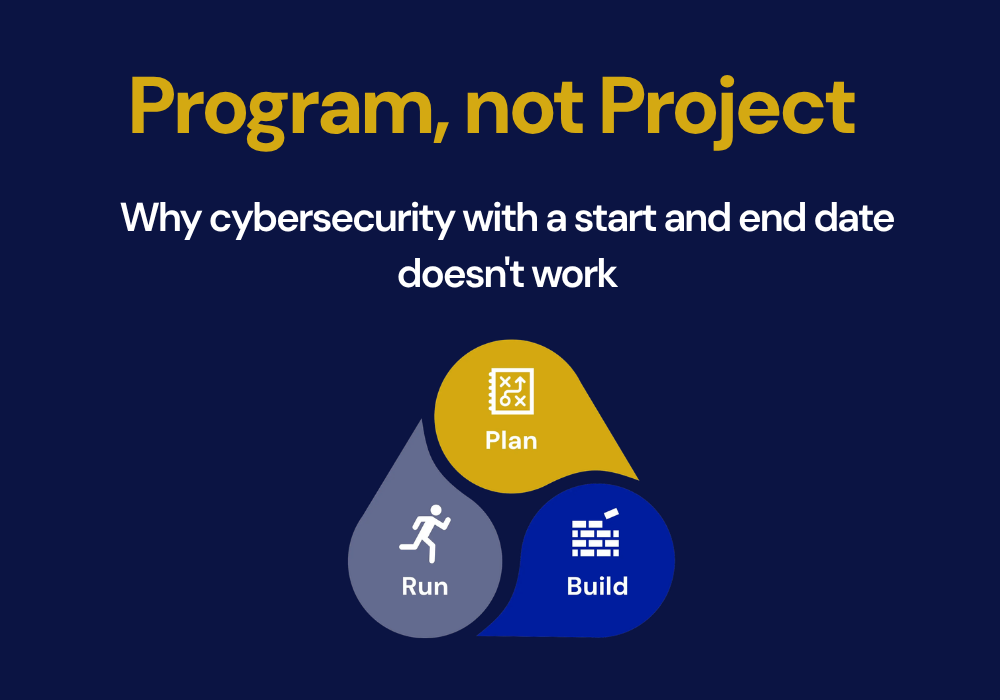
Everything we do at Fellsway follows one operating model: Plan. Build. Run.
Plan sets direction. Build implements the controls and writes the policies. Most firms are happy to sell you those two phases, because they have a clean start and a clean finish. They map neatly onto a project.
Run is the phase that doesn’t. Run is ongoing oversight, testing, reporting, and keeping the program alive as your business and your risk keep changing.
Run is the tabletop exercise that finds a gap before an attacker does. It’s the re-check that catches a control a vendor quietly broke. Run keeps the board report current, so it’s ready the day it’s asked for rather than rebuilt the week before.
It’s where a program stops looking like a project, and it’s the part a project-shaped engagement leaves out.
Run works two ways:
Someone competent has to be running it after the certificate goes up. Whether that’s us or your team is your call.
When a program keeps running, the outcomes are the ones your business is measured on.
And when someone resigns, the program keeps running, because the knowledge never lived in one head.
That’s what our free cybersecurity workshops prepare you for. They help you understand what kind of program you should put in place; they don’t promote a project for sale.
The certificate on the wall was never the goal. Operating with confidence, through every change and every incident, long after the project would have ended, is.
Risk is constant. Ready is a choice.
If you want a program that’s still working in eighteen months, not a project that expired quietly, talk to us. We’ll walk through where you stand today and what it takes to stay ready as everything around you keeps moving.
Get the latest cyber and AI insights to help your organization stay compliant, resilient and ready for ever-evolving threats and challenges.
Because while risk is constant, ready is a choice.
When an incident threatens your business, the way your leadership team responds makes all the difference in how...
Read more
The ransom note is on the screen and the clock is running. Your IT team knows what the next hour looks like:...
Read more
You've been told to get AI governance in place. Sooner or later every manufacturer lands here, the early movers...
Read moreLet’s help Plan, Build and Run your cyber and AI programs to keep your business capable, compliant, and resilient. Because while risk is constant, ready is a choice.