In February, IBM’s 2026 X-Force Threat Intelligence Index put manufacturing at the top of the ransomware target list for the fifth straight year. It accounted for 27.7% of all incidents X-Force observed in 2025.
Not a close second to healthcare or financial services. The most attacked sector, by a significant margin.
If you run a mid-market manufacturing operation, the question isn’t whether attackers are interested in companies like yours. They clearly are. The question is whether your business can keep operating when one of them succeeds.
The economics are straightforward. Manufacturing has the lowest tolerance for downtime of any major sector. When production stops, revenue, customer commitments, and supplier contracts all start taking damage at once.
Attackers know this. X-Force found that extortion was the leading attack outcome for manufacturers in 2025, followed by data theft targeting intellectual property. The ransom-or-lose-production calculation is exactly what the attacker is counting on.
Legacy operational technology makes it easier. A significant portion of manufacturing environments run industrial control systems on software that can’t be patched and hardware that wasn’t designed for network connectivity. Dragos, which tracks OT-specific threats, has consistently found that most vulnerabilities disclosed in industrial environments have no available patch.
Attackers aren’t breaking through sophisticated defenses. They’re walking through doors that have been open for years.
And the threat landscape is broadening. Active ransomware and extortion groups surged 49% in 2025, with smaller operators entering the market using leaked tooling and AI-assisted automation.
Vulnerability exploitation became the single leading cause of attacks in 2025, accounting for 40% of all X-Force incidents. For manufacturers running unpatched OT environments, that’s the relevant number.
The total cost of a ransomware incident has become harder to pin to a single figure, partly because the range is wide and partly because organizations have gotten better at not paying ransoms. Looking at 2025 incidents, Sophos put:
Additional industry analysis puts total incident cost, including downtime, recovery, legal, and indirect losses, between $1.8 million and $5 million per attack.
Those averages are useful, and largely beside the point. The number that matters is what an incident would cost your operation: your production rate, your open orders, your contractual penalties, your specific insurance coverage.
For most mid-market manufacturers, nobody has ever run that calculation. The number that comes out the other side is usually what finally gets leadership’s attention.
Recovery cost is only part of the picture. The average disruption from a ransomware attack now runs 24 days before full operational restoration.
In a manufacturing environment where downtime has a measurable per-hour cost tied to production output and contract exposure, 24 days is a material event regardless of whether a ransom is ever paid.
Cyber insurance won’t automatically close that gap, if you even know what your policy covers. Premiums in the sector keep rising, and underwriters are asking for more at renewal, including:
Most mid-market manufacturers have something on paper, like an incident response (IR) plan written two or three years ago, or a disaster recovery document that covers the ERP but doesn’t extend to the production floor.
But that’s not a tested capability.
The 2026 X-Force data on recovery times is telling. Organizations with tested incident response plans recovered significantly faster than those without formal procedures.
The gap shows up when the ransom note appears and your COO needs to know which production lines to take offline first, your legal team needs to know whether and when you’re obligated to notify regulators, and your executive team needs to know what to tell customers and whether your insurer has been contacted.
Those decisions don’t get made cleanly without a process that’s been run before. And in manufacturing, the time spent figuring it out is production lost.
X-Force also found that supply chain and third-party compromises have nearly quadrupled since 2020. For manufacturers with supplier integrations feeding into scheduling or production systems, the attack surface isn’t just internal.
Your resilience program needs to account for what happens when the disruption comes through a vendor, not just through your own perimeter.
A resilience program for a mid-market manufacturer isn’t a compliance checkbox. It’s a set of tested answers to the questions that come up during a real incident.
It starts with a business impact analysis (BIA). You need to understand which of your processes are most critical, what the financial and contractual consequences are if each one goes offline, and how long each can realistically be down before the damage becomes severe.
Those numbers shape everything downstream, from recovery time objectives to investment priorities to the conversations your CFO has at insurance renewal.
Your resilience program should also include crisis management and incident response built across functions, connecting IT, security, legal, operations, and executive leadership so decision-making runs cleanly under pressure.
The technical containment is one piece. The business-level response is the rest: communication, disclosure, authority, customer management.
And it must get tested. Tabletop exercises that run your leadership team through realistic scenarios will surface the gaps in your decision-making process, and produce documented evidence you can show to a board, a regulator, or an underwriter. Resilience without proof isn’t readiness.
The manufacturers that recovered faster in post-incident reviews weren’t the ones with the most sophisticated technical teams.
They were the ones who’d run the response before they needed it.
Our operational resilience readiness workshop takes your leadership team through a structured session that maps your actual exposure, identifies your recovery priorities, and gives you a clear picture of where you stand before you need to find out the hard way.
If your cyber insurance renewal is coming up, underwriters will want to know this. They’re paying attention to the same data you’re reading here. They don’t just want to know “if you have an IR plan” but “when was it last tested, with whom, did it include OT, and what changed after?”
Book your free workshop today, and we’ll help you answer those questions.
Because risk is constant. Ready is a choice.
Get the latest cyber and AI insights to help your organization stay compliant, resilient and ready for ever-evolving threats and challenges.
Because while risk is constant, ready is a choice.
When an incident threatens your business, the way your leadership team responds makes all the difference in how...
Read more
The ransom note is on the screen and the clock is running. Your IT team knows what the next hour looks like:...
Read more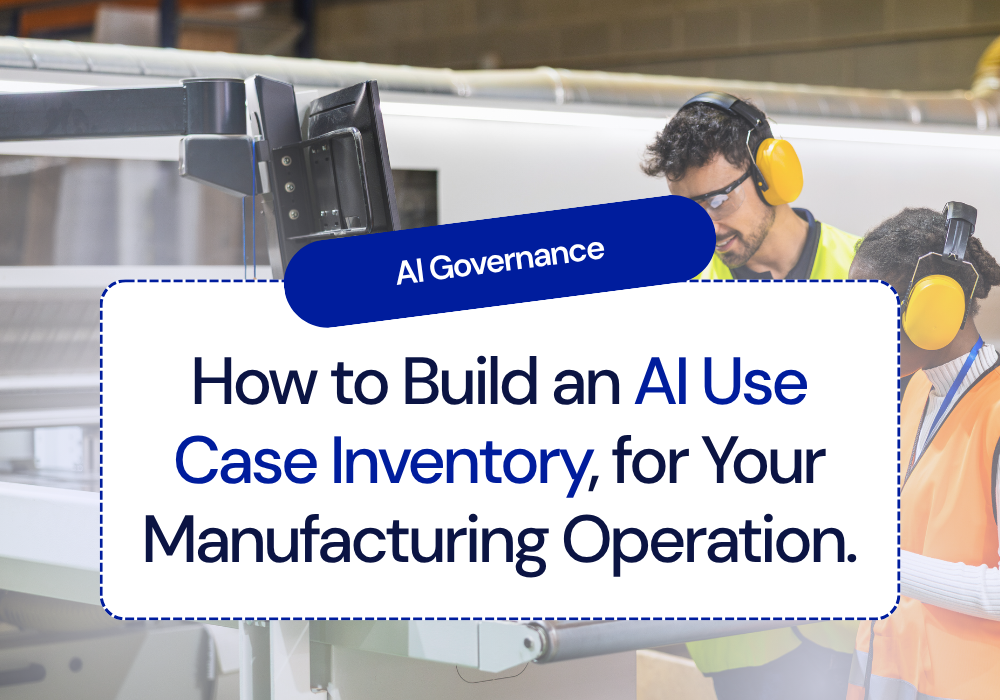
You've been told to get AI governance in place. Sooner or later every manufacturer lands here, the early movers...
Read moreLet’s help Plan, Build and Run your cyber and AI programs to keep your business capable, compliant, and resilient. Because while risk is constant, ready is a choice.