Most companies meet a cyber or compliance problem the same way. They go looking for something to buy before they understand what they’re dealing with.
A tool. A consultant. An assessment with a quote attached.
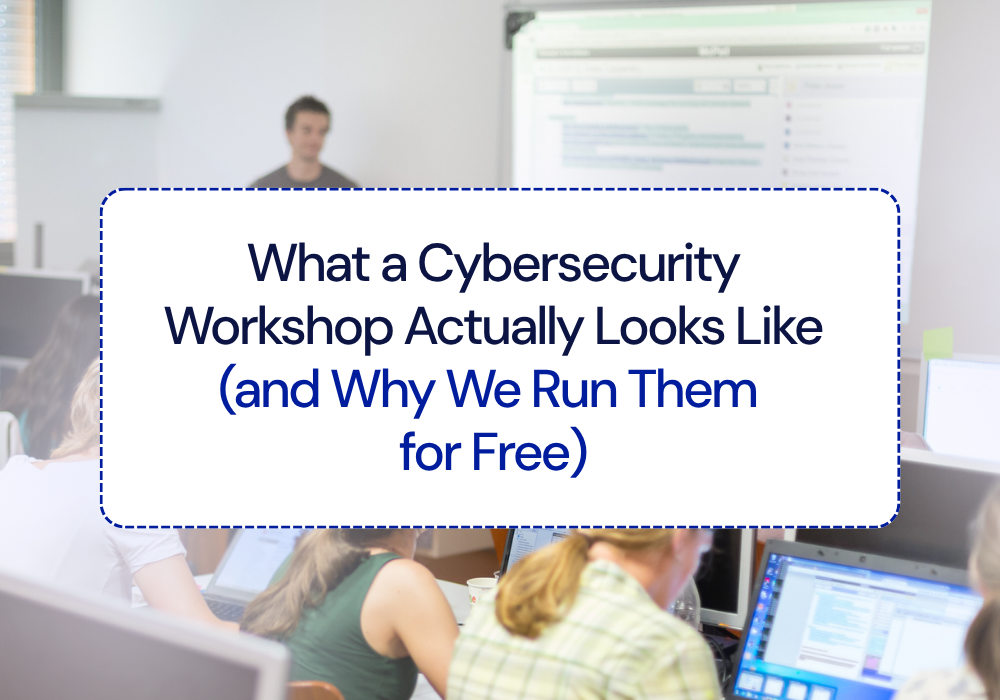
Our workshop runs the other way around. One hour, with the right people in the room, to get a clear read on where you stand and a recommendation you can act on.
No cost, no sales pitch.
Which usually raises the question we hear most: if it’s that useful, why is it free?
We don’t run a single cybersecurity workshop. We run the one that fits the problem in front of you.
A defense manufacturer chasing a DoD contract needs the CMMC Readiness Workshop.
A leadership team worried about operating through a major incident needs the Resilience Readiness Workshop.
A company moving fast on AI needs the AI readiness version.
Different requirements, different stakeholders, different questions.
What stays the same is how we work. We discover where you actually are, and we map what it takes to get where you need to be. Then we recommend a specific next step.
The focus of our workshops changes to align with your organization’s needs. Our method doesn’t.
The session moves quickly from your business context to a clear recommendation. It’s tightly structured, because we’ve run this enough times to know which questions matter and in what order.
In a CMMC workshop, we read your current posture against the four key readiness indicators, then tell you whether you need to build a program from scratch or validate the work you’ve already done. You leave knowing whether CMMC even applies to you, where you stand, and what to do next.
In a resilience workshop, we work through six operational dimensions, from governance and ownership through to whether your plan has ever been tested under real pressure. You leave with the priority gap to close first, and why it matters more than the others.
That only works if the right people are in the room.
Resilience isn’t an IT problem, and CMMC isn’t only a compliance one. We want the executive who owns the budget, the IT or security lead who knows the environment, and the person actually running the effort.
The people who’d be in the room during a real incident are the people we want in the room for the workshop.
An hour sounds short for something this consequential. It works because the process is well-defined and we know what to ask.
We’re not learning your business from scratch on the call. We’re applying a structured discovery to it, guided by the patterns we’ve seen across hundreds of programs. The dialogue does the heavy lifting. These problems don’t come off a line card, so the answer comes from the conversation, not a template.
Keeping it to an hour is deliberate. Your stakeholders have day jobs. Their time is expensive, and pulling four senior people into a half-day session they didn’t need is its own kind of waste.
We’d rather give you a focused hour that earns its place on the calendar.
An audit tells you what’s wrong. It hands you a list of findings, marks the gaps, and leaves you to work out the priority order and who owns each fix. You come away with more problems than you started with and no sequence for solving them.
An RFP runs into a different wall. It asks you to specify the solution before you understand the problem. You write requirements for a program you haven’t scoped, vendors quote against them, and you pick from options that may not match what you actually need. The specification was the guess.
The workshop starts with dialogue instead. We figure out the shape of the problem with you, then point you at the right next step. You get direction before you commit a dollar, not after.
Because we want companies to take action that sticks. And we believe in the importance of readiness.
We see a lot of money spent on solutions and services that organizations never get the full value from:
Our reason for being is making sure companies can take meaningful action and operationalize the capability underneath it, not just buy the thing that’s supposed to deliver it.
An hour of our time, up front, is how we make sure you start in the right place. If you walk away and run the program yourself, that’s a good outcome.
If you decide you want us to Plan, Build, and Run it with you, that’s a good outcome too. Either way, you’re moving forward understanding instead of guesswork.
We’re operators, not just advisors. The workshop is where we start so the next decision you make is the right one.
If you want to know where your organization actually stands, book a workshop.
In just 60 minutes, you’ll have a clear next step.
Because risk is constant, and ready is a choice.
Get the latest cyber and AI insights to help your organization stay compliant, resilient and ready for ever-evolving threats and challenges.
Because while risk is constant, ready is a choice.
When an incident threatens your business, the way your leadership team responds makes all the difference in how...
Read more
The ransom note is on the screen and the clock is running. Your IT team knows what the next hour looks like:...
Read more
You've been told to get AI governance in place. Sooner or later every manufacturer lands here, the early movers...
Read moreLet’s help Plan, Build and Run your cyber and AI programs to keep your business capable, compliant, and resilient. Because while risk is constant, ready is a choice.